Metadata record
这是元数据记录,而非可下载的文件。你可以使用这个链接来请求文件。 若你拥有的文件未被安娜的档案收录,请考虑上传文件。
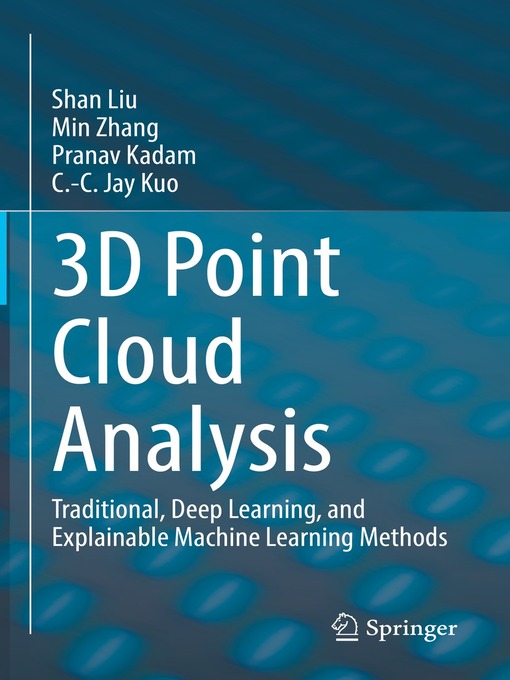
3D Point Cloud Analysis 🔍
Shan Liu; Min Zhang; Pranav Kadam; C.-C. Jay Kuo
Springer International Publishing, 2021
元数据 · 英语 [en] · 2021 · 📗 未知类型的图书 · libby · Libby 8227695
描述
This book introduces the point cloud; its applications in industry, and the most frequently used datasets. It mainly focuses on three computer vision tasks — point cloud classification, segmentation, and registration — which are fundamental to any point cloud-based system. An overview of traditional point cloud processing methods helps readers build background knowledge quickly, while the deep learning on point clouds methods include comprehensive analysis of the breakthroughs from the past few years. Brand-new explainable machine learning methods for point cloud learning, which are lightweight and easy to train, are then thoroughly introduced. Quantitative and qualitative performance evaluations are provided. The comparison and analysis between the three types of methods are given to help readers have a deeper understanding.
With the rich deep learning literature in 2D vision, a natural inclination for 3D vision researchers is to develop deep learning methods for point cloud processing. Deep learning on point clouds has gained popularity since 2017, and the number of conference papers in this area continue to increase. Unlike 2D images, point clouds do not have a specific order, which makes point cloud processing by deep learning quite challenging. In addition, due to the geometric nature of point clouds, traditional methods are still widely used in industry. Therefore, this book aims to make readers familiar with this area by providing comprehensive overview of the traditional methods and the state-of-the-art deep learning methods.
A major portion of this book focuses on explainable machine learning as a different approach to deep learning. The explainable machine learning methods offer a series of advantages over traditional methods and deep learning methods. This is a main highlight and novelty of the book. By tackling three research tasks — 3D object recognition, segmentation, and registration using our methodology — readers will have a sense of how to solve problems in a different way and can apply the frameworks to other 3D computer vision tasks, thus give them inspiration for their own future research.
Numerous experiments, analysis and comparisons on three 3D computer vision tasks (object recognition, segmentation, detection and registration) are provided so that readers can learn how to solve difficult Computer Vision problems.
With the rich deep learning literature in 2D vision, a natural inclination for 3D vision researchers is to develop deep learning methods for point cloud processing. Deep learning on point clouds has gained popularity since 2017, and the number of conference papers in this area continue to increase. Unlike 2D images, point clouds do not have a specific order, which makes point cloud processing by deep learning quite challenging. In addition, due to the geometric nature of point clouds, traditional methods are still widely used in industry. Therefore, this book aims to make readers familiar with this area by providing comprehensive overview of the traditional methods and the state-of-the-art deep learning methods.
A major portion of this book focuses on explainable machine learning as a different approach to deep learning. The explainable machine learning methods offer a series of advantages over traditional methods and deep learning methods. This is a main highlight and novelty of the book. By tackling three research tasks — 3D object recognition, segmentation, and registration using our methodology — readers will have a sense of how to solve problems in a different way and can apply the frameworks to other 3D computer vision tasks, thus give them inspiration for their own future research.
Numerous experiments, analysis and comparisons on three 3D computer vision tasks (object recognition, segmentation, detection and registration) are provided so that readers can learn how to solve difficult Computer Vision problems.
备选作者
Liu, Shan; Zhang, Min; Kadam, Pranav; Kuo, C.-C. Jay
开源日期
2024-09-11
- 未找到下载。
有关此文件的详细信息,请查看其JSON 文件。 Live/debug JSON version. Live/debug page.